Buyer Tool · CZD Product References
Match The Decision To The Equipment Family
Use the product pages to check the physical model, then confirm the project-specific drawing, load, finish, and packing scope.Quick Buyer Answer
Use private label for speed, ODM when a proven shelf or cart platform needs adaptation, and full OEM only when the design ownership and development effort are justified. CZD can combine 3D design, custom dimensions, fittings, color, capacity, samples, and controlled BOM revisions.
Use the guide below as a conversation starter with your supplier. You do not need a perfect specification before asking for help; the important thing is to make the open decisions visible and compare like with like.
Decision Snapshot
Select the lightest development route that solves the commercial need. Put drawings, sample scope, tooling ownership, performance requirements, branding, change control, and pilot approval in writing before the project becomes a production commitment.
| Route | Best fit | Control point |
| Private label | Standard product, fast launch | Color, logo, packaging and codes |
| ODM | Proven platform with changes | Changed interfaces, tests and revision |
| OEM | Buyer-owned strategic design | Tooling, validation, ownership and IP |
| Pilot | Risk reduction before rollout | Real assembly, packing and store test |
What To Send For A Quote
- Must-have performance and brand requirements
- Drawings, BOM, sample and test ownership
- Tooling, confidentiality and exclusivity terms
- Pilot quantity, approval gates and scale-up plan
Retail fixture development works best when the buyer chooses the smallest amount of uniqueness that creates commercial value. Private label can change color, logo, packaging, and codes on a standard product. ODM adapts a proven shelf, cart, checkout, or display platform. Full OEM gives the buyer more design control, but adds tooling, validation, ownership, revision, and scale-up work.
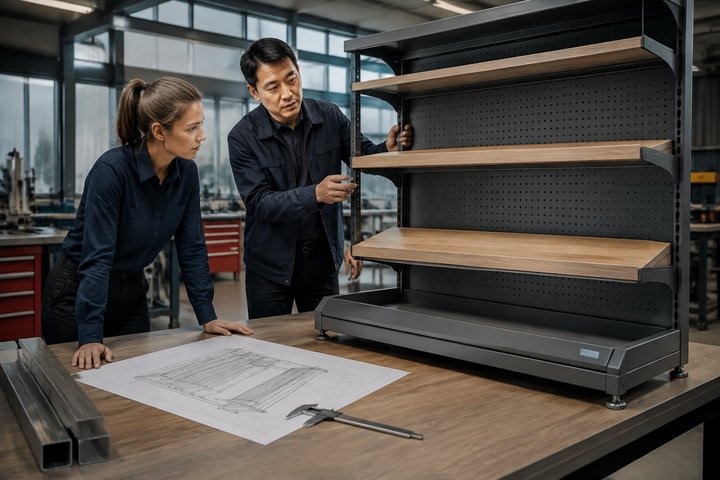
CZD's standard and customized capabilities include 3D design, dimensions, capacity, thickness, fittings, color, wood appearance, sample direction, BOM preparation, packing, and quotation support. Define what is being adapted and what remains a proven platform before calling the program OEM or ODM.
Choose The Development Route
Use private label when the standard fit and performance are acceptable and launch speed matters. Use ODM when a known platform needs changed dimensions, accessories, finish, or branding. Use full OEM when the design, interface, or market differentiation is strategic enough to justify engineering and validation cost.
| Route | Useful for | Buyer must control |
| Private label | Fast launch and repeatable standard | Color, logo, packaging and codes |
| ODM | Proven product with adaptations | Changed interfaces, sample and revision |
| OEM | Buyer-owned design or unique system | Drawings, tooling, tests, ownership and changes |
Create A Revision-Controlled Technical Package
Use drawings, material and finish specifications, a BOM, critical tolerances, load or stability requirements, approved samples, inspection points, packing artwork, labels, and spare compatibility. Mark which dimensions are critical and which can use a standard CZD interface. A sample without a controlled drawing is difficult to reorder or audit.
Clarify Tooling, Branding, And Ownership
Record tooling cost, ownership, storage, maintenance, expected life, permitted use, and transfer conditions. Separate buyer-owned design features from the supplier's existing platform and manufacturing know-how. Define confidentiality, logo and packaging files, exclusivity, and the approval process for any material, fixture, or process change.
Validate With A Pilot Before Rollout
Approve an engineering or appearance sample, then run a pilot batch at normal production speed. Check assembly, load, finish, packaging, transport damage, installation time, cleaning, customer interaction, and the compatibility of spare parts. Do not scale a design that was only built slowly by a senior technician or only photographed in a showroom.
Protect Future Reorders
Attach the approved component codes and drawing revision to each purchase order. Require change notification for steel thickness, material supplier, tooling, coating, connection, factory location, or packaging. CZD can keep standard and customized options visible in the BOM so the pilot, rollout, and future stores remain comparable.
Next Step For Your Project
Start with a brief that separates must-have performance, brand choices, target cost, and future options. CZD Shelves can support private-label, ODM, and controlled OEM development with 3D design, samples, BOM revisions, and production approvals.